
Based on my new article in Statistics and Public Policy: “One Person, How Many Votes?”.
We are quickly heading into the 2026 midterm elections in the United States, with Democrats trying to retake the Senate and House of Representatives.
The big story has been the redistricting battle, with Republicans aggressively redistricting in the wake of Supreme Court decisions rolling back the Voting Rights Act. This will make representation in the House of Representatives much less representative, on both racial and partisan lines. It could be the end of only sixty years of real representation, which only began with the Voting Rights Act and several Supreme Court decisions requiring equally-apportioned House districts.
The issue of representation in the House is magnified because it the only of the three elected bodies (the House, Senate, and Presidency) that is elected in a way even close to proportional representation. The Senate awards two seats to each state (and none to the District of Columbia or Puerto Rico), whether the under 1 million-person Wyoming or the nearly 40 million-person California. The Electoral College selects the president, with each state getting a number of votes equal to its House representation plus its two Senate seats, distorting the relative weight of each state.
This leads to extreme inequality in representation by state. A Wyoming voter in a Senate or presidential election has much more weight than a California voter.
It also distorts the demographics of the country as a whole in their representative bodies. White and rural voters are more common in states that are overrepresented in the Senate and Electoral College. Using 2020 Census data, we can see how much the country’s population is distorted when filtered through the apportionment into the House, Senate, and Electoral College.
Race/Ethnicity
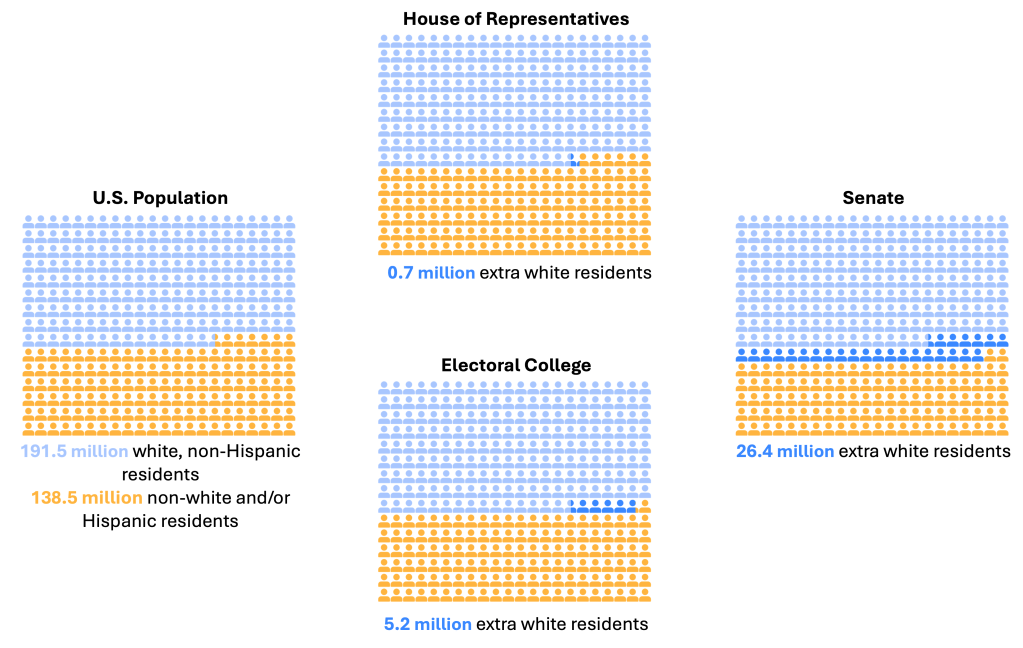
White, non-Hispanic residents make up about 58% of the population, followed by Hispanic residents (of any race) at 19% and Black, non-Hispanic residents at 12%. In the representation of the Senate, though, white non-Hispanic residents comprise 66% of the population. In other words, the represented population in the Senate has about 26.4 million extra white residents, 20.2 million fewer Hispanic residents, and 6.3 million fewer Black residents, and 4.9 million fewer Asian residents. In the Electoral College, the represented population has 5.2 million extra white residents.
Rural/Urban Residents
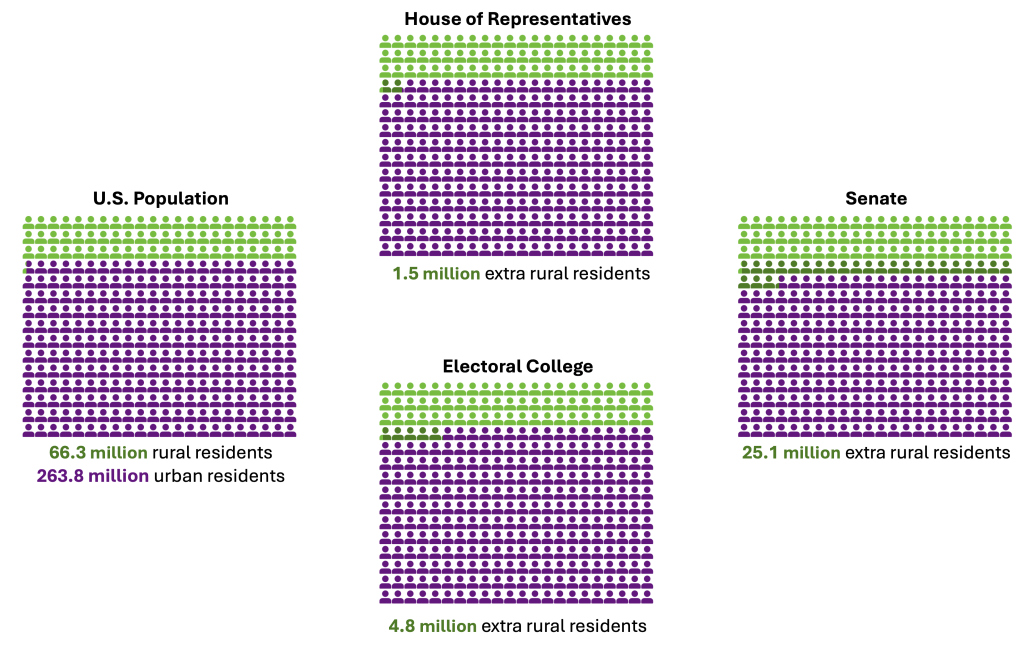
The Census has a pretty expansive definition of urban, counting any settlement with over 5,000 residents. Under this definition, the population is 80% urban and 20% rural. In the Senate, however, rural residents have 1.52 times as much representation as urban residents. That’s equivalent to 25.1 million additional rural residents and 25.1 million missing urban residents. In the Electoral College, the representation effectively shifts 4.8 million residents from urban to rural.
Why the House Matters
Under the Constitution and current Electoral College system, the House of Representatives is left as the only body that closely represents the true population, rather than distorting it. But that represented population does not translate into the elected representatives under massive partisan and racial gerrymandering. So the threat to democracy in the House is a threat to the only truly representative institution in the U.S. federal government.
Links
For more details on methods and additional results, see my article “One Person, How Many Votes?”.
For an interactive app with additional options and demographic factors, visit https://bit.ly/Elec-Weights.


